

Field notes: the rains came late this year
Unpredictable weather is changing the way our partner farms plan their year. Our agronomist wrote this after a visit to the groundnut belt.
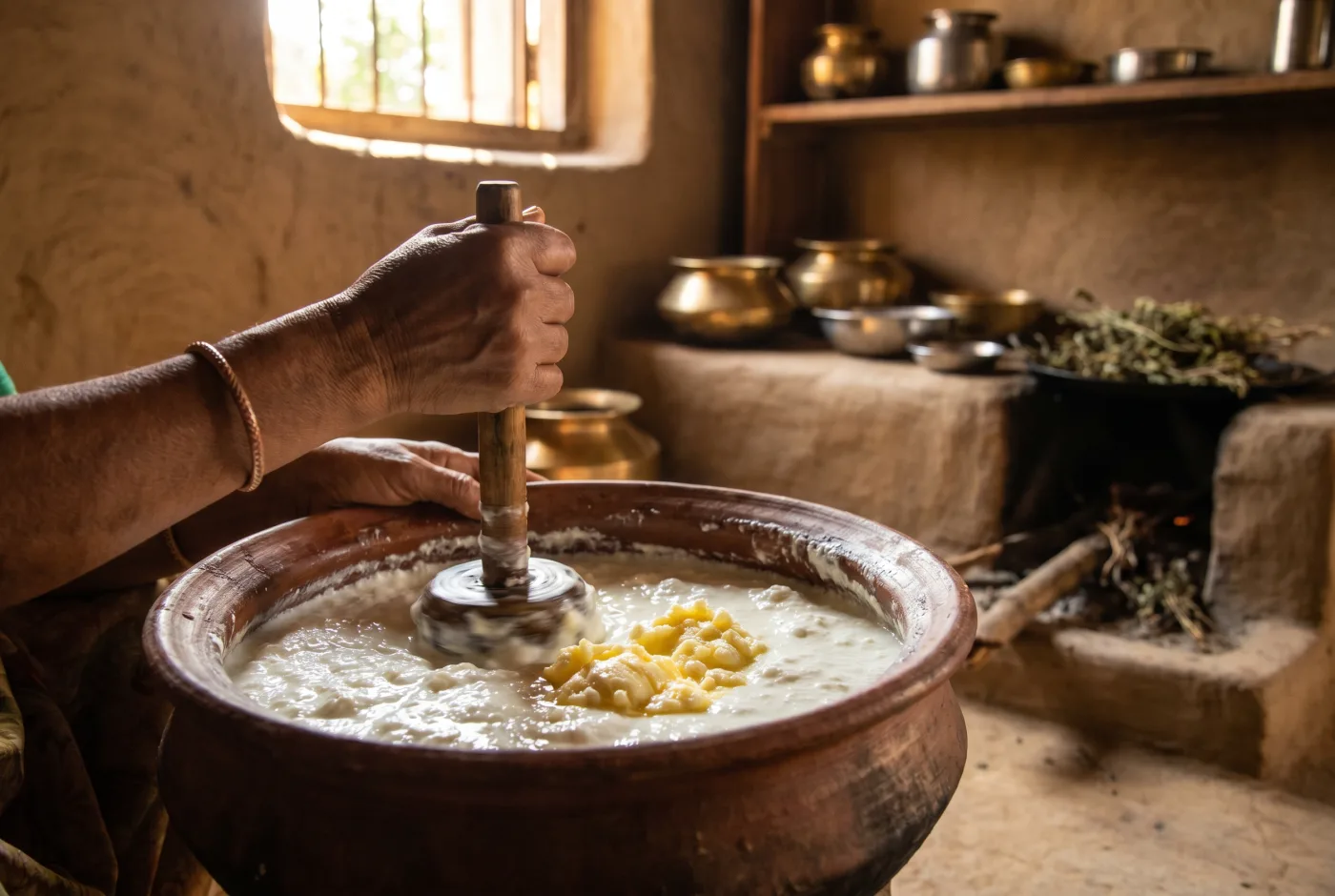
Almost every food we sell has a faster version, and ghee is no exception. A modern creamery can turn milk into finished fat in a few hours. We take five days. Bilona is slow by design, with three days of churning and two of resting, and that pace comes from chemistry. Nothing in modern dairy technology has found a way to shorten it.
The science behind the slowness
When milk is cultured at a low temperature for 48 hours, the lactic-acid bacteria break down more of the lactose. Churn that curd by hand, at the right rhythm, and it gives up a butter with a different fatty-acid profile: shorter-chain triglycerides, more conjugated linoleic acid and more of the aromatic compounds that give ghee its smell.
"I learned from my grandmother. The butter tells you when it's done. You don't tell it."
Why we won't industrialise it
Several large dairies have asked about white-labeling our ghee using continuous-flow centrifuge methods. We politely declined. That route gives a higher yield and a lower cost per jar, but what comes out of it is a different product. We would rather sell fewer jars of the real thing than more jars of something we couldn't stand behind.
Scan the lot code on your jar and you will see Hetal's name, the day the milk was set and the day the ghee was bottled. That receipt is our contract with you, and it is the reason this company exists.